Thursday, November 14, 2013
Home again, and some news
My friend Karin is in the guild, and I stayed the night with her, and we talked quilting, fabric and dyeing most of the time we were awake. I also spoke about my business and the recent craft show experience. One goal with a real deadline was applying for state-wide juried status with the Pennsylvania Guild of Craftsmen. So, the deadline is tomorrow, November 15, and I got my submission done today! And, by the way, I have already been juried at the Lehigh Valley Chapter level.
One of the quilts I am submitting for jurying is not currently in my hands. It is with Shannon Shirley, and it is going to be included in an upcoming book to be published by Schiffer Publishing. But if I am selected for the jurying session (no guarantees) I'll be able to get the quilt here in time. And the really cool part is that Shannon told me it will be included in the exhibit at the upcoming Quiltfest Destination Savannah in the end of March, 2014. Keep your eyes open for it, and I'll post a picture of it on this site when the exhibit is unveiled.
Monday, November 11, 2013
Post 3 – missed these yesterday
Since I had thickened black and navy MX dye, here’s some more of what I did:
Black circles monoprint, lower right, and a ghost print from the same surface on the left.
Since I mixed up guar gum for use in the devoré paste, I took a little and squished it on fabric. It was very thick; not too different an end result than I’d expect from using print paste as a resist.
Three elements in this photo: in the upper left is plumber’s putty, or the poor dyer’s gel plate.Yes, it’s oily, but I haven’t noticed any staining on cotton. The yellow at the bottom is a big veggie sack – I pressed that into the putty with a roller (pipe.) The resulting fabric is in the upper right – a piece of pink snow-dye with spots of thickened navy dye. The dye was not as thick as it might have been, so I saw it beading up on the surface of the putty. Definitely doing more with the putty.
Sunday, November 10, 2013
All the stops, post #2
OK, all these photos were taken over the course of several day’s work – they’re not all from today.
The first picture shows the results of yesterday’s devoré plus disperse test. The dye looks blackish-purple before heat-setting, and the pink seersucker burned out very nicely. The pink color comes from MX.
Next is an piece of orange snow-dye. Not bad, just a little boring.
So it has been overdyed with navy. Next step: vat dyes!
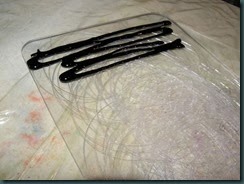
This picture shows a scarred piece of polycarbonate with thickened black dye at one end.
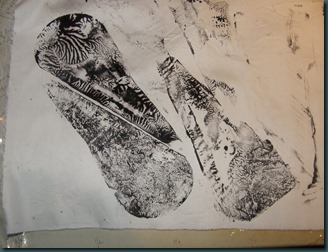
Here are a couple prints that were made from that piece of polycarb. Probably a close-up would help – the circles are pretty fine, and interesting, I think.
This is a piece of broadcloth with Deep Navy MX dye. The reason it looks like cheesecloth is that it was a test of my old Inkodye resist. I spread it on, pressed the cheesecloth into it and let it dry. Then it was thoroughly glued down, so I had to moisten it in order to remove the cheesecloth. The resist came away with the cheesecloth.
Here is a piece of snow-
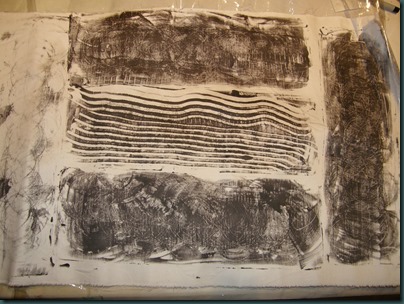
Finally, this is very thick black MX that was spread on the smooth side of the polycarbonate shape used above. Another petal-shaped piece of plastic was used to squish the thickened dye and lift it off. I was reminded of this technique by Sue S in the UK, and I love it! I’m glad I used an interesting shape, too!
Still on the list of stuff to play with – discharge/vat dye, if it’s nice tomorrow afternoon. Must bind up the orange/navy for that.
Thanks for looking!
Saturday, November 09, 2013
Pulling out all the stops weekend, part 1
My post from the 29th is about my decision to stay home from the craft show in Virginia. Since then I’ve spent a lot of time tidying and putting things away in the studio, so I have room to work. And most of the past three days I’ve been practicing and experimenting and learning more about some techniques I’ve underutilized. So here are some photos, just of the devoré so far:
This is a picture of a poly-cotton blend fabric. I’ve screened devoré paste on the fabric through a Thermofax screen, let it dry and then ironed it. Once ironed, I washed out the cotton portion of the fabric, leaving the poly behind.
Here’s the same fabric after washing out the cotton. It’s held up to the light because that’s the best way to see the resulting pattern.
Here’s a look at testing the pH of the devoré paste – gloves are a must! If you’re not up on your pH numbers, 7 is neutral, soda ash is alkaline, about 11 or 12, and vinegar is 2.4 – 3.4 according to this site.
And here’s the next set of samples. It shows two fabrics with devoré paste mixed with disperse dyes. The results should at least show up better than the second picture does. More later!
Tuesday, November 05, 2013
Thinking about Intent
This is probably my first completed art quilt.
It was made for a guild challenge in 2002, and won a prize for best original design, I think. The challenge, as you may guess, was to work with the Shoo-Fly pattern. I had also learned a little by that point about transparency and wanted to try using that in a quilt. I’m still proud of it – I accomplished what I set out to do: finish a quilt for the challenge – and I think it exceeded my expectations once I saw it all together.
Some months later I realized that the resulting quilt was also a piece of mourning for the events of September, 2001. The colors are somber and the quilting made me think of ashes falling. Not part of the intent, and the quilt stands alone fine. Is it art? Is it better for having a title? I don’t know, but I still like and am proud of the quilt. Thanks for looking – Lisa
Tuesday, October 29, 2013
The show that wasn’t
Recently I posted on some of the several lists and groups I belong to asking for feedback on whether or not to vend at a fine craft/art show. Here’s what I wrote:
I just got back from a fine craft show for which I wasn’t prepared. The booth cost $100 and I sold $55, and I slept at home. I didn’t promote it to my mailing list. There’s another one November 8-10; DH thinks I should stay home and I’m on the fence. I’ve already paid out $400, but if I go, there’s lodging and travel (which is painful for hubby) – say another $500, plus a door prize that I’d have to make. I can learn from my mistakes and advertise it to the folks on my mailing list – there are lots in the area – and go there anyway and take a chance. Will quilt show attendees come to a fine craft show?
I got a lot of great feedback on both sides of the question – 33 emails and a phone call. Thank you so much to everyone who took the time to reply. The bulk seemed to be on the ‘stay’ side; on top of which I went to the show’s website and Facebook page, which in my opinion didn’t do anything to instill confidence. Plus there’s another show with a similar name about 80 miles away that is competing head to head for a lot of the same attendees.
The final result – I decided to stay home and work. I told hubby he could feed me. (Is that just cashing in too much on his guilt?) Then I told him seriously – “let’s try another, bigger show that’s close to home.” And of course, we’ll be at Hampton, VA and Somerset NJ in the late winter again next year!
Here’s a view of my booth at the Lehigh Valley chapter of the Pennsylvania Guild of Craftsmen show – the Holiday Marketplace at the Swain School. There’s a new look for me – a canopy
frame with black drapes.
Here’s a new idea – matted pieces of fabric displayed on an easel. One of the good ideas I picked up at the Allentown show.
The show was very nice, and many vendors had good sales. Maybe next year I will too! Thanks again to those who responded, and thanks for reading!
Friday, June 14, 2013
Fabrics
In 2011 I had access to a photographing microscope, so of course I had to take pictures of fabric. The first is cotton sateen, and I think it’s very interesting. The rest are cool, too. My descriptions are not at all technical, and might be wrong. It’s just what I’ve picked up over time. I dye, I don’t weave.
Sateen front – selvedge is on the right. A sateen weave is ‘over several, under one, (or fewer than it went over.)’
Sateen back – selvedge on the left.
Broadcloth – the basic over 1 – under 1 plain weave we learned making potholders.
NuSuede polyester microfiber – the smooth back.
Radiance cotton-silk sateen. This is the back cotton side.
Radiance – the front / silk / warp side.